For the complete Meanest Link story in sequence, see parts one, two and three.
The Meanest Link, final installment
This article was written by Huntsville writer Don McCormick. It first appeared in a slightly different form in the August 2005 issue of Muskoka Magazine.
Says Thomas: “Day nine was the best day on the entire trip. The end of the Nipissing was gorgeous; we saw three moose, we didn't have to wear our bug jackets, the humidity had dropped and, when we saw Cedar Lake and the AO store across a calm lake, we bolted for it.”
They were met onshore by Jake Pigeon, the manager of the Algonquin Outfitters store at Brent. He, quite literally, was raised in Algonquin Park and is very knowledgeable about it. Pigeon got them settled into the bunkhouse, which to them seemed like a palace. The canoe trippers dried their gear, washed their clothes, ate “real” food, drank cold beer, slept in a bed, had interesting conversations with Jake and baked their first ever pie. Thomas wrote, “Brent is like heaven,” in her diary.
The next day, AO co-workers Chuck and Greg arrived with the second food drop. The atmosphere was very festive. Dinner together, card games, dressing up in silly hats and glasses and having a dance party rounded out a perfect day.
“We didn't want to leave. The thought that we still had to work our way home was painful,” recounts Sanders. Their cordial time at Brent was one of the high points of the trip.
The following day dawned cool and overcast, the gloominess of the day reflecting their mood on leaving Brent's hospitality. Their route was down Cedar Lake, along the Petawawa River to Radiant Lake and up the Crow River to Lake Lavieille. The Crow River turned out to be worse than the Western Boundary, with an incredible 23 portages totaling about 10 km. They arrived at Lavieille at 9:30 p.m., camped at Swifty's favorite campsite and had one of his favorite brands of beer in his honor.
Next morning, there was a cold north wind blowing. With the help of strong tailwinds, the four paddlers sailed down Lavieille and Dickson lakes to the infamous 5.3 km portage - the same one Swifty claims the record portaging time - into Lake Opeongo. If they broke Swifty's record, it would have been wind-aided.
On Opeongo, they lashed their canoes together and, with a tarp for a sail, they raced down Opeongo in the pouring rain. “We were cold and wet but we were so happy because we weren't paddling,” says Capell. With their arrival at the Opeongo AO store, they had completed three of the four “Meanest Links.”
The next day turned out to be their longest of the trip - over 11 km of portaging in 15 hours of travel. It was cold. By now, all four women were thinking of home. The Madawaska River meandered maddeningly. There were beaver dams to lift over and the women were tired. There was the side trip into Camp Pathfinder at Source Lake that would add another “unnecessary” six portages to the trip. They arrived at their Tea Lake campsite after dark.
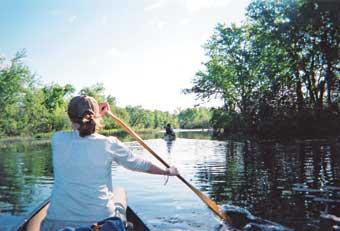
On the morning of their last day of the trip, all four were up at the usual 5 a.m. Under the cold and overcast sky, they paddled down Tea Lake into the Oxtongue River. They were getting close to home.“High Falls was a high point. Once you hit there, you're almost home,” says Strickland. “I was so excited I couldn't stop smiling,” recalls Sanders. When they rounded the corner and came under the bridge, the whole staff of the Oxtongue Lake AO store was out to welcome them home, mosquito bites and all.
That was a very emotional time. They had been planning this trip for a long time and, now, it was over. They had taken up this very difficult challenge and succeeded. Their sense of accomplishment was huge. Their friendships were strengthened by the shared experience. Their appreciation for the support of their friends “went off the scale.”
The “Meanest Link” was indeed the trip of a lifetime for friends Thomas, Capell, Strickland and Sanders, and an appropriate event to mark this very special period in their lives. Swifty has been honored, too.
The Meanest Link, continuedThis article was written by Huntsville writer Don McCormick. It first appeared in a slightly different form in the August 2005 issue of Muskoka Magazine .
For background on the Meanest Link, see “The Meanest Link - part one” and "The Meanest Link - part two" Meet the paddlers. Sarah Strickland grew up in beside Algonquin Park. She is an accomplished athlete and canoe tripper who guides canoe trips for AO. She graduated from Laurentian University this past spring in biomedical biology and will be heading to medical school at the University of Ottawa in September. Janet Thomas is a third year sociology student at McMaster University who has worked at AO for the past eight summers as an outfitter. Leah Sanders is going into her last year in geography at the University of Ottawa. Jaime Capell has spent the past few years, since graduating from Huntsville High School, working and traveling. She will be attending Sheridan College in September in an illustration program. None of them will have any problem writing the proverbial, “what I did for my summer vacation essay.”
"All my friends think I'm crazy", says Capell. Why would they want to take on such a difficult undertaking? For all of them, it was the challenge. They'd all done canoe trips, but none had done one this long or this difficult. They wanted to be the first ones to complete the “Meanest Link.” Doing the trip with three of their closest friends at a point in their lives when their paths are beginning to diverge made it that much more special. All saw it as “the trip of a lifetime. There were other reasons for doing the trip - scenery, wildlife; getting to know the park better, especially some of the less well-traveled parts, and improving their tripping skills.
Along with any challenge comes anxiety. Foremost in their minds were the “bugs” - blackflies and mosquitoes. Strickland puts the problem in perspective. “With the bugs comes good water levels, fewer people, the ability to all get two weeks off together. So, it was, do it with the bugs or don't do it at all.”
Another source of anxiety was the magnitude of the physical challenge. Could they do it? All thought they could do it, but self-doubt niggled below the surface. The heavy physical demands would produce frustration. People say and do things, sometimes hurtful things, in the heat of frustration. Would their friendships survive?
Injury was a concern too. How would they manage if someone broke an ankle? Fortunately, Strickland is very well-qualified to deal with injury in the bush. And, they'd all done a lot of planning. Baker was confident they were well prepared.
6:30 a.m., June 6, 2005: They launched two canoes from the AO dock at Oxtongue Lake. The route for the first link - Oxtongue River, Lake of Bays, Peninsula Lake, Fairy Lake, Muskoka River, AO dock in Huntsville - took 15 hours. It was a hot, humid day and, “The headwinds and waves were insane,” recalls Sanders.
Day two was the start of the Huntsville-Brent leg - Big East River to McCraney Lake, then through a series of small lakes and portages and down the Nipissing River to Brent. It started out well but, very quickly, the water levels dropped and the journeyers started scraping bottom. All four had to get out of their canoes and drag them through the water. It was hot and humid and the flies were on them with vengeance. The rocks were slippery with algae and the footing was treacherous.
“By the end of the first day, I think we finally realized what we were in for,” explains Strickland. “We looked like we had chicken pox on our faces and necks because of blackfly bites.”Their maps for this section were also very sketchy. It was very difficult to know where they were and, therefore, to know how much more of this kind of travel lay ahead. “We'd turn the corner and all we could see was more rocks. I almost cried that day. I just wanted the dragging to be over,” notes Thomas.
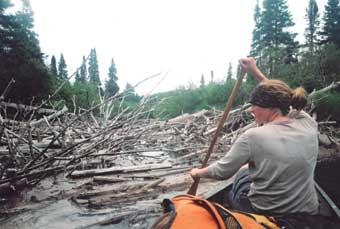
They finally got off the Big East River and into McCraney Creek. With this, they had moved into uncharted territory. It was only two and a half km up the creek to McCraney Lake - a short day. But the creek turned out to be even worse than the Big East. Low water, slippery rocks, dead trees strewn across the creek made it impossible to paddle. Packs had to be hauled out of the canoes and the canoes dragged and lifted over rocks and fallen trees. Heat, humidity and flies added to the burden. At one point, they thought they had found a shortcut into McCraney Lake along an old trail through the bush. But, a very difficult portage in the extreme heat steered them right back into McCraney Creek. Eventually, they had to give up, short of their goal for that day.
Says Capell: “That was my worst day. I felt so defeated. I was hot, tired, falling on every step.” McCraney Creek was the low point of the trip for all of the women.
The next morning, they were on the water at 7 a.m. determined to make it to McCraney. Again, it was very hot and the bugs were ruthless. They made McCraney by noon. “We nearly cried with joy. I have written in my journal 'Best day ever,' ” says Sanders. They paddled out to an island, had a great lunch, swam and dried out their wet clothing. The following day they paddled to the end of the lake to find AO co-workers Chuck, Will and Randy waiting for them with a food drop.
“It was fantastic. Just to see them really boosted us,” says Capell. Will and Randy had made the first attempt on the “Meanest Link” in the late autumn of 2004 and had to abandon it. They understood how difficult it is.
At McCraney Lake, they were finally into Algonquin Park. Being in the park meant designated campsites, marked and cleared portages, an accurate map, established canoe routes - “it was the start of good things,” says Strickland.The next part of the route, up to the Nipissing River, was through a succession of small lakes connected by portages. That day turned out to be the hottest day of the whole trip. There were over 9,000 meters of portages - all uphill. The lakes were so small that you could see the next portage from the end of the previous one. The intense heat and continuous portaging produced heat and chafing rashes and the bugs wore them down emotionally. “Today was so hard I just wanted to stop,” writes Thomas in her log.The next day and a half was spent on the Nipissing River. There was no shade on the river and the sun and heat were intense. Onshore, the mosquitoes were the worst they had ever experienced. By now, timewise, they were halfway through the trip.
To follow up on “part one,” I was fortunate enough to secure permission to reprint a story from Muskoka Magazine. This article was written by Huntsville writer Don McCormick. It first appeared in a slightly different form in the August 2005 issue of Muskoka Magazine. I have added a few details about the link story, which appear in italics.
The Meanest Link by Don McCormick
Four college women conquer adventure route with honors
There's a look about people who have taken on something very challenging and succeeded at it. It's a mellow, satisfied, self-confident glow.
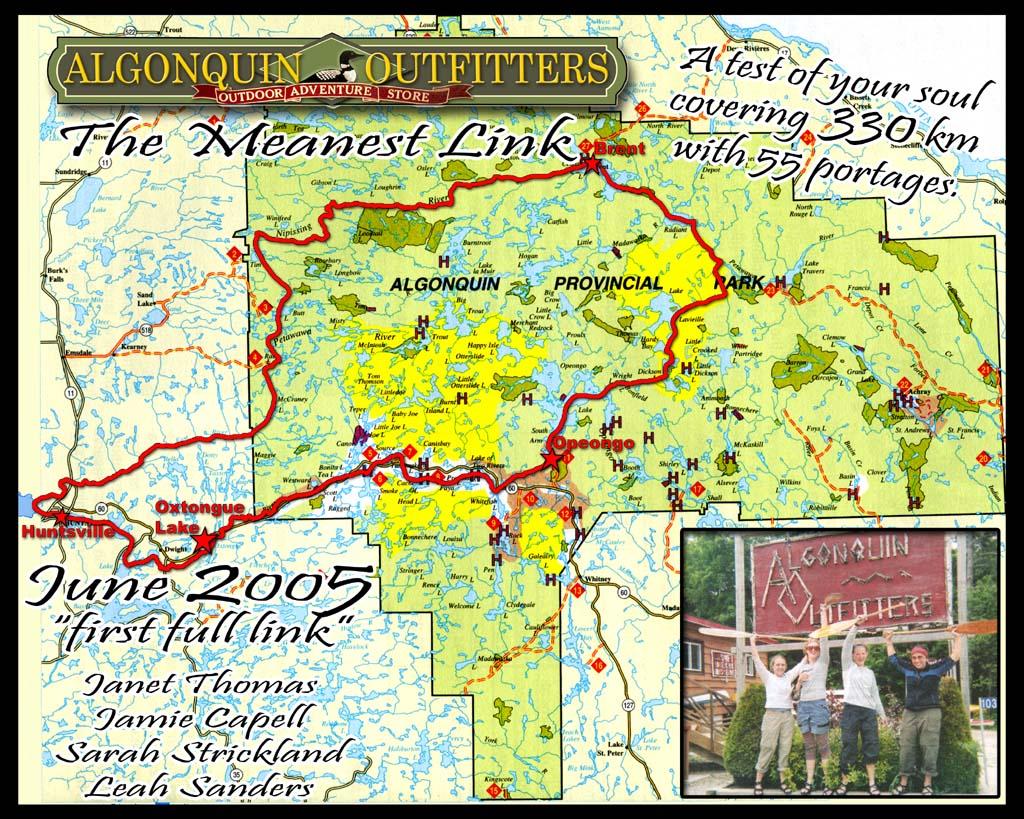
It's the look you see on the faces of Janet Thomas, Jaime Capell, Sarah Strickland and Leah Sanders - four young tough-minded women who took on and completed the “Meanest Link” canoe route in Algonquin Park - a 330 kilometre journey with 55 portages.
Their story starts at the Algonquin Outfitters (AO) store at Oxtongue Lake this past June. All four women had worked there over the past several summers and had become close friends. With some of them graduating from university and moving on to careers, this may be their last summer working together at AO. The occasion called for something special - something like the “Meanest Link” canoe trip to mark this period of their lives.
The “Meanest Link” canoe route is the brainchild of Gord Baker and Alex Hurley. Baker is the assistant general manager of Algonquin Outfitters. Baker wanted his AO staff to take more canoe trips to recommit themselves to AO's core activity of canoe tripping. The “Meanest Link” challenge is the core ticket.
Completing the route itself would also serve to honor the memory of AO founder Bill Swift Sr., better known as “Swifty”, who passed away in 1999. Swifty had "...a gruff exterior and a heart of gold,” according to Baker. One of his nicknames - one Swifty particularly favored - was “Meanest.”
The trip links the four AO Stores - Oxtongue Lake, Huntsville, Brent and Opeongo - hence the name “Meanest Link.” There are four tough legs to the trip - Oxtongue Lake to Huntsville, Huntsville to Brent, Brent to Opeongo and Opeongo back to Oxtongue Lake.
Other staff members had completed individual sections of the link over the previous summer and fall. Two male staff members, Will Lougheed and Randy Pielsticker, had tried to complete the whole loop in early November 2004 but had to cut their trip short due to bad weather, low water and the fact that they were running out of food. Given the marginal weather, short days, unknown terrain on the Big East River and generally challenging conditions, their accomplishment is significant.
The route does not take the conventional or easiest path. The Huntsville to Brent section goes up the Big East River to McCraney Lake, through a series of small lakes and portages (the “Western Boundary” route, well known to trippers from Camp Pathfinder) and then down the Nipissing River to Brent. This leg is, by far, the most difficult portion of the “Meanest Link.” The mean factor includes relentless swarms of mosquitos and blackflies, low water, snags, deadfalls, huge portages, heat and humidity and the unknown.
The route also includes side trips to Source Lake, the site of Camp Pathfinder, and to Lake Lavieille. Swifty had been a camper, counselor and even one time owner of Camp Pathfinder. Lake Lavieille was Swifty's favorite place in Algonquin Provincial Park and the route includes the famous Dickson-Bonfield, five km portage for which Swifty claimed to hold the record portaging time. Enduring was more on the minds of the four women when they set off than setting records.


 For a brief background on the development of the Meanest Link, see “The Meanest Link - part one”
